
Zone X, X500, and AE — What Your Flood Determination Actually Means
"It's not in a flood zone."
Every house is in a flood zone. FEMA has mapped the entire country. What people mean when they say that is "it's not in a zone where my lender will force me to buy flood insurance," and in Galveston County that distinction is worth understanding before you write an offer, not after your lender orders the determination.
The three you'll actually see
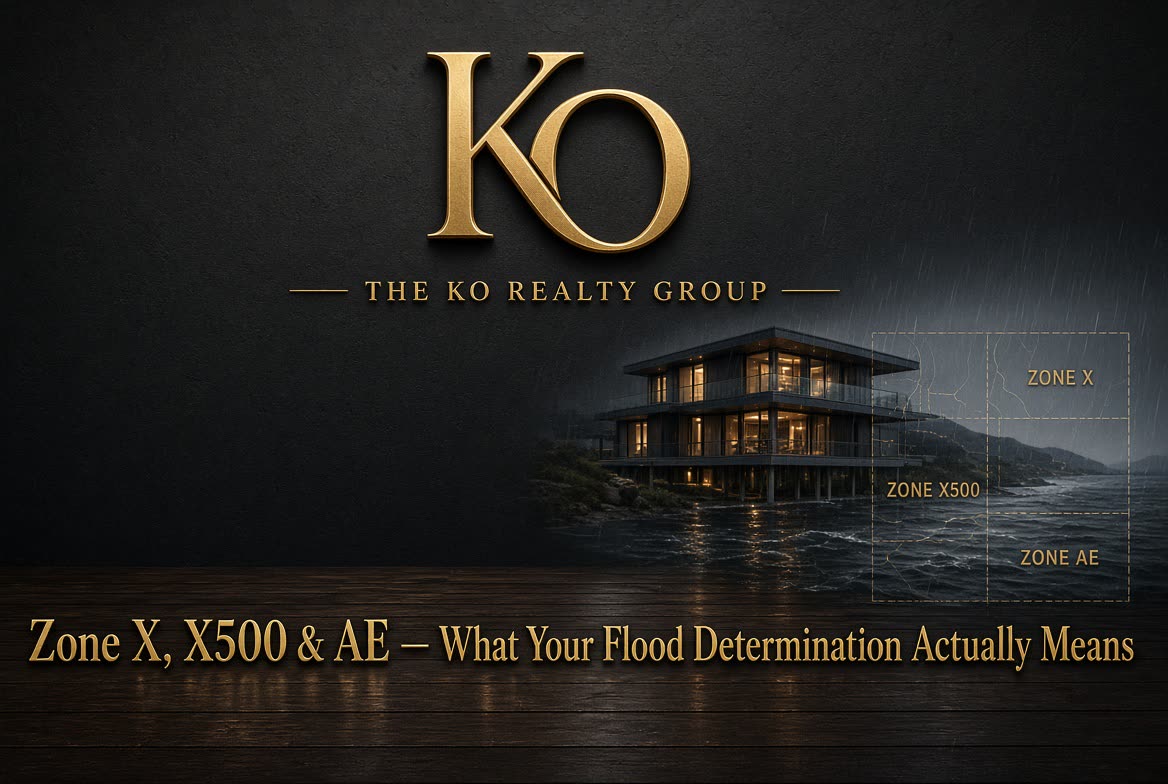
Zone X — outside the Special Flood Hazard Area. Below the 0.2% annual-chance floodplain. This replaced the old Zone B and Zone C designations, which is why a 1990s survey might say "Zone C" for a property that maps as X today.
Shaded Zone X, also written X500 — the 0.2% annual-chance floodplain, which everyone calls the 500-year zone. Still outside the Special Flood Hazard Area. Also includes some shallow-flooding areas and land behind levees.
Zone AE — the 1% annual-chance floodplain, the 100-year zone. This one is inside the Special Flood Hazard Area, and it comes with a published base flood elevation.
Who has to buy insurance
Federally regulated and insured lenders must require flood insurance on properties in A and V zones — the high-risk designations. That's the mandatory purchase requirement, and AE falls under it.
Zone X and shaded X/X500 carry no federal requirement. Your lender can still impose one as its own credit policy — some portfolio lenders do — but nobody is federally obligated to make you buy it.
That's the practical difference buyers care about, and it's why "X500" on a flood determination is meaningfully better news than "AE."
The part almost nobody knows
Here's what surprises people, including a lot of agents.
Under FEMA's current NFIP rating methodology, flood zone is no longer a premium rating factor. Your NFIP premium is built from the characteristics of the building itself — elevation, foundation type, replacement cost, distance to water — not from which letter appears on the map.
So "I'm in X, my flood insurance will be cheap" is reasoning from an old rulebook. The zone determines whether you're required to carry it. The building determines what it costs.
Two houses, both Zone X, can quote very differently. Get an actual quote during your option period rather than assuming.
And the number that should stick with you
Roughly 29% of NFIP flood claims come from properties rated moderate-to-low risk.
Not required to have coverage. Nearly a third of the claims.
On the upper Texas coast, where the flooding that hurts people is usually rainfall-driven rather than storm-surge-driven, that number is the whole argument for buying a policy you aren't required to buy. Zone X premiums commonly land in the $450–$500 a year range. That is not a lot of money to be wrong about.
How to read a determination properly
Don't stop at the letter. Get these four things:
The zone. X, shaded X/X500, AE, VE.
The panel number and effective date. Something like 48167C0043G, effective 8/15/2019. FEMA revises maps. A property mapped X on a 2019 panel might have been something else on the 1999 panel, and a pending map revision can change it again. The date tells you how current your information is.
Whether it's in or out of the Special Flood Hazard Area. This is a separate yes/no field and it's the one your lender acts on.
Whether it's within 250 feet of a different flood zone. This field exists because zone boundaries are lines on a map, and being ten feet outside one is different from being a quarter mile outside one. A property well away from any boundary gives you less to argue about with an underwriter — and less to worry about at the next map revision.
Two things to ask the seller
The seller's disclosure asks directly about previous flooding, previous water penetration, and whether the owner has ever received FEMA or SBA flood assistance. Read those answers.
FEMA's map tells you the statistical risk. The disclosure tells you what actually happened to that specific house. They are different questions and you want both answered before your option period runs out.
What I'd actually tell you
Zone X or X500 with a clean disclosure and no boundary within 250 feet is about as good as it gets in this county — my current League City listing is exactly that, and it's worth confirming in writing rather than taking anyone's word for.
Then buy the policy anyway. It's five hundred dollars against a number that starts with a comma.
Kelli Owens is a Texas REALTOR® with The KO Realty Group, brokered by The Sears Group. TREC License #616346. This is general information, not insurance advice — confirm your flood zone, requirements, and premiums with your lender and a licensed insurance agent.
Send me an address. I'll pull the FEMA panel, zone and effective date.
The zone, the panel number, whether it's inside the Special Flood Hazard Area, and whether it's within 250 feet of a different zone. In writing, before you're emotionally committed.
Keep reading
 MUD, PID, LID — What They Cost You, and What They Actually AreA MUD can add $362 a month to an identical house. Most buyers have never been told what these di…
 Why the Square Footage Never Matches — CAD, Appraiser, and Floor PlanThree sources, three numbers, and none of them are wrong. Here's what each one measures and…