
Zone X vs. Zone AE — What Flood Zone Actually Costs You on Galveston Island
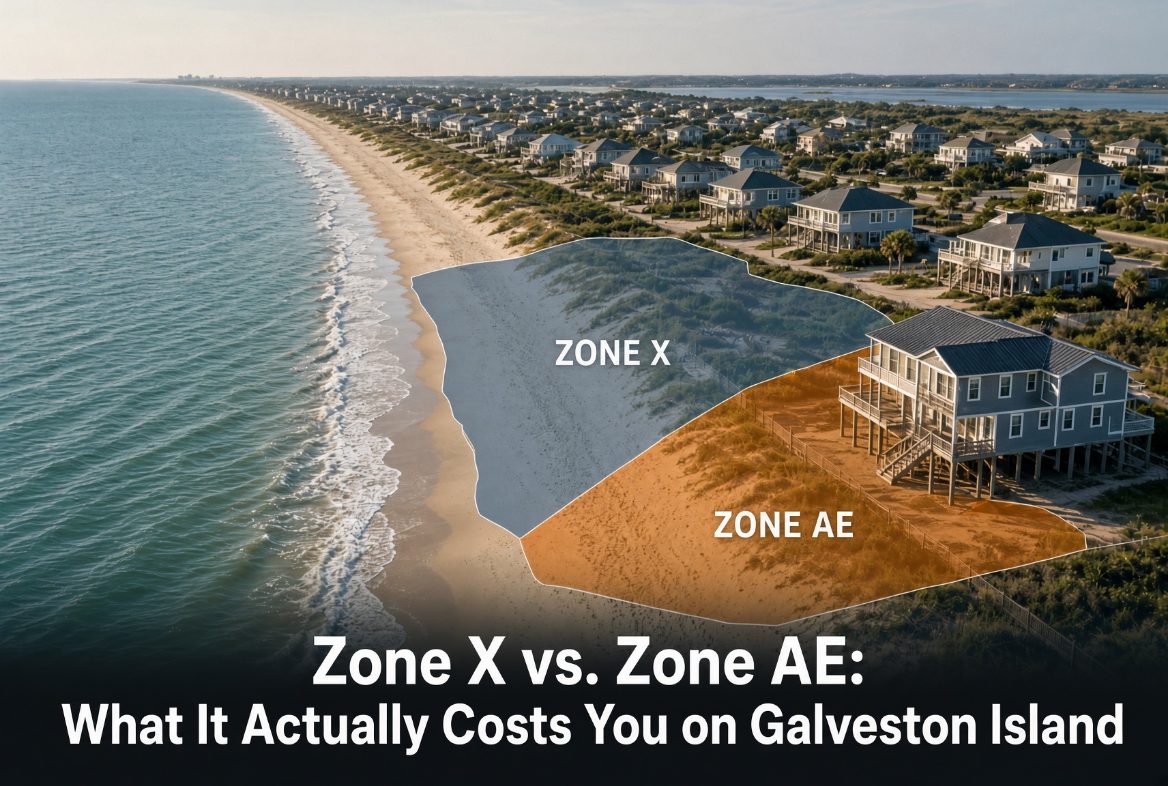
Nearly every property on Galveston Island carries some flood zone designation — the question that actually matters is which one, because the difference between zones can run into thousands of dollars a year in insurance, and it determines whether your lender requires flood coverage at all.
What the zone letters actually mean
Zone AE / A / V / VE — these are Special Flood Hazard Areas (SFHA), meaning FEMA's flood insurance rate maps show at least a 1% annual chance of flooding, sometimes called the "100-year floodplain." If a property sits in one of these zones and carries a federally regulated or insured mortgage, flood insurance is legally required, not optional.
Zone X (unshaded) — minimal flood hazard. Outside both the 100-year and 500-year floodplains. Flood insurance isn't required here, though FEMA still recommends it.
Zone X500 (shaded) — moderate flood hazard, inside the 500-year floodplain but outside the higher-risk 100-year zone. A two-tenths of one percent annual chance of flooding. Not a federally required purchase, but most lenders and insurers treat it as materially different from unshaded Zone X.
Why this matters more on the island than almost anywhere else in the county
Off-island Galveston County properties — League City, Dickinson, further inland — see a real mix of zones, including plenty of Zone X and X500 parcels outside any flood hazard area. On the island itself, the barrier-island geography means a much higher share of properties fall inside Zone AE or similar SFHA designations. Don't assume island-adjacent means island-equivalent risk; check the specific parcel every time.
How to actually check a property's zone
Don't rely on a listing description or a neighbor's guess. Pull the FEMA Flood Insurance Rate Map (FIRM) for the specific parcel — it'll give you the zone, the panel number, and the map's effective date. Properties within roughly 250 feet of a zone boundary deserve extra scrutiny; a home just outside Zone AE on paper can still carry real flood risk in practice, and boundary lines occasionally shift when FEMA updates a panel.
What the disclosure actually tells you — and doesn't
Texas seller's disclosures ask whether the seller is aware of previous flooding from a natural event, previous water penetration into the structure, and whether the property carries current flood insurance. A seller answering "no" to prior flooding and "yes" to current coverage is a good sign — but a disclosure only covers what the seller knows and experienced, not a guarantee about future risk. Pull the FIRM yourself; don't rely on the disclosure as your flood-risk research.
The insurance math
A property in Zone AE with a federally backed mortgage will need a flood policy on top of standard homeowners coverage — often the single biggest line item difference between owning a Zone AE property and a Zone X one nearby. Get an actual flood insurance quote during your option period, not an estimate. Rates vary based on elevation certificates, first-floor height, and the specific FIRM panel, not just the zone letter alone — two houses in the same zone can carry meaningfully different premiums based on elevation data.
The bottom line
A flood zone designation isn't a reason to walk away from an island property — it's a cost to underwrite accurately before you make an offer. Get the actual FIRM panel, get an actual insurance quote, and read the seller's disclosure for flood history specifically, and you'll know the real number instead of guessing at it after closing.
Kelli Owens is a Texas REALTOR® with The KO Realty Group, brokered by The Sears Group. TREC License #616346. This is general information, not legal, tax or insurance advice — confirm the rules, classifications and costs for your specific property with the City of Galveston and your own licensed professionals.
Send me an address. I'll pull the FEMA panel, zone and effective date.
The zone, the panel number, whether it sits inside the Special Flood Hazard Area, and whether it's within 250 feet of a different zone. In writing, during your option period.
Keep reading
 Zone X, X500, and AE — What Your Flood Determination Actually MeansEverything is in a flood zone. The question is which one, whether your lender will requir…
 Is a 140-Year-Old House Insurable? Financing and Insuring a Historic Galveston HomeHistoric homes are harder to finance and insure than typical resale properties. Here's wh…